

9 Ways CFOs Build Trust With the Board
Tips for navigating incentives, alignment, and boardroom dynamics
Board management is one of those skills most CFOs have to learn in real time. You can be strong operationally, sharp on the numbers, deeply strategic, and still walk out of a board meeting feeling like you didn’t quite land it. Even with the best preparation, the boardroom operates on a different set of dynamics shaped by incentives, personalities, trust, timing, and subtext.
In a recent exchange with our CFO|Circle members, we asked a simple question: What’s your best advice for building strong board relationships?
The responses across the community showed that the best path involves building trust early, navigating tension before it compounds, and showing up as a strategic partner (not just the person who reports the numbers).
Here are nine habits that consistently make a difference.
1. Lead With an Owner Mindset
When you show up as an owner instead of a reporter, the dynamic shifts. You’re there to drive outcomes, which means driving the agenda, flagging what’s coming, and keeping the conversation focused on long-term value.
As one member put it: “Behave like an owner who cares about enterprise value maximization and you are aligned automatically.”
Open with a simple framework of here’s what we’re doing, here’s why we’re doing it, and here’s what we need from you.
2. Get Aligned With the CEO First
Board influence starts with CEO alignment. Several CFOs emphasized that managing the board ultimately runs through the CEO. If the CFO and CEO send mixed signals on strategy, risk, tone, or priorities, boards will feel it immediately, and once triangulation begins, it’s difficult to unring that bell.
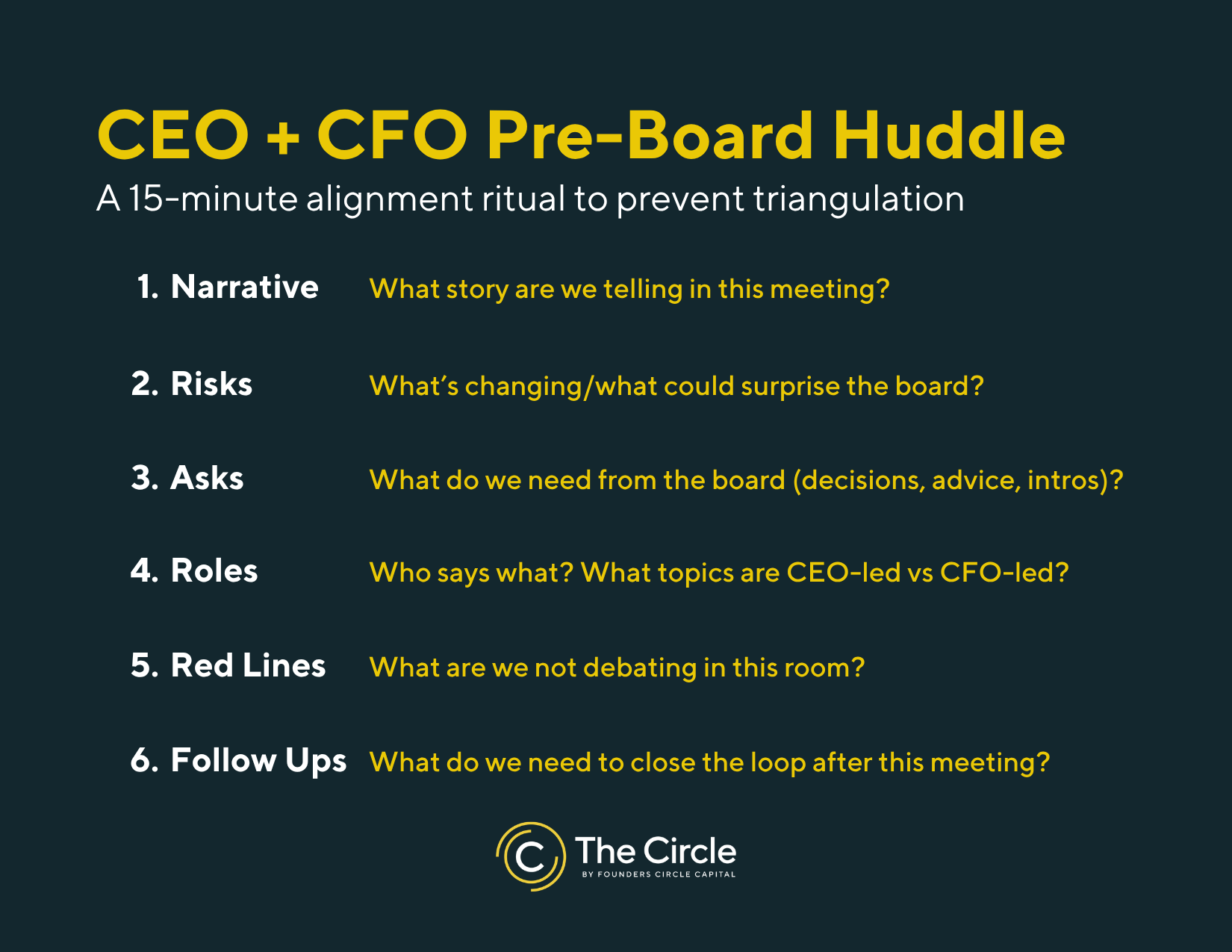
The most effective CFOs are trying to reinforce board confidence in the executive team as a unit. Before each board meeting, hold a pre-board alignment huddle to clarify:
- The core narrative
- The key risks
- The specific asks
- Who owns which parts of the conversation
- What gets escalated vs. handled internally
3. Invest in Board Relationships Between Meetings
The board meeting is where relationships are tested, so it’s important to focus on relationship building outside of the boardroom. If the only time a board member hears from you is in the board meeting, you’re operating at a disadvantage.
CFOs shared that monthly 1:1s with key board members are a cornerstone habit. This is especially valuable in fast-moving organizations where board meetings can become too compressed to build context in real time.
Monthly 1:1s can be used for pre-wiring decisions before they’re up for debate, surfacing concerns early before they become public tension, and turning board members into advocates rather than adversaries.
4. Practice “No Surprises” as a Discipline
Nearly every member echoed some version of this sentiment – no surprises, good or bad!
“No surprises” doesn’t mean over-communicating every fluctuation. It means exercising judgment about what’s material and flagging it early.
When a CFO flags risk early and brings a plan, it demonstrates competence and confidence. When a CFO waits until the board meeting to introduce a problem, it can create unnecessary escalation and sometimes, a loss of trust that takes quarters to rebuild.
5. Use Consistent Reporting to Create Clarity
Board materials that change structure at every meeting means the board spends time orienting rather than advising. Focus on changing the story instead of the framework.
The shift from reporting to strategic partnership often comes down to delivering the headline, backing it up with facts, and adding insight they haven’t thought of yet. Maintain a stable reporting structure with consistent KPIs, consistent budget vs. actual formats, and predictable “where to look” patterns that reduce cognitive load.
The goal isn’t about making everything look polished. Instead, your focus should be on making information usable. Send pre-reads early, ask for questions, and answer them in the meeting. Ultimately, consistency builds credibility over time and makes real changes stand out clearly.
6. Study What “Success” Means to Each Board Member
Board dynamics get easier when you stop treating “the board” like a single entity. Every board member shows up with their own incentives, internal pressures, reporting obligations, fund dynamics, and personal style.
Many members stressed the importance of understanding what “winning” looks like for each individual. When you understand their context, you can anticipate pushback, frame decisions more effectively, and reduce friction before it starts.
One suggestion was to create a board member profile for each person:
- what they’re accountable for (returns, impact, legacy)
- their pressures (fundraising, portfolio performance, reserves)
- their style (detail, high-level, skeptical, supportive)
→ Download a Board Member Profile Worksheet template
7. Know the Cap Table and the Economics Behind It
Several CFOs called out that investor board members carry their own internal incentives and constraints. Members highlighted the importance of deeply understanding:
- Who invested when
- At what price
- What their gain levels look like
- How valuation trends impact their fund
Fund stage, entry price, and internal firm dynamics shape behavior especially around liquidity, bridges, pro-rata, and risk tolerance. When you know the cap table cold, you can anticipate where incentives may diverge, frame financing conversations thoughtfully, and avoid personalizing economically-driven behavior.
8. Anticipate the Questions Before They’re Asked
Boards tend to focus on a predictable set of pressure points, such as runway, growth efficiency, hiring plans, margin trajectory, and execution gaps. When those themes surface reactively, the conversation can feel defensive vs. when they’re anticipated, the tone shifts entirely.
A strategic CFO keeps a running “board FAQ,” a clear view of the questions most likely to come up, and thoughtful answers prepared in advance. Some go a step further and build a concise, one-page appendix for likely challenges so they can address them calmly and directly if needed.
Consistently anticipating the board’s concerns before they’re voiced shows pattern recognition, preparation, and command of the business, which builds trust quickly.
9. Engage the Difficult Board Member Early
Almost every board has a member who is the skeptical voice, the constant comparator, the one quick to reference another portfolio company. Ignoring that dynamic rarely works and when left alone, it can quietly erode team confidence or shift meeting energy in unproductive ways.
CFOs consistently advised engaging these individuals early, especially in 1:1 settings. Seek out their pattern recognition. Ask what they’re seeing across the portfolio.
Often, what feels like friction is simply a different vantage point or pattern-recognition bias based on past experiences. When you proactively address comparisons and explain what’s distinct about your company’s context, the dynamic changes.
Handled intentionally, the “difficult” board member can become one of your sharpest thought partners.